New Blood, New Noise: Meet the Gen Z Artists Rebuilding Rock From the Ground Up
Forget everything you think you know about what rock music is supposed to sound like. The kids making it right now didn't grow up with one genre — they grew up with every genre simultaneously, piped directly into their earbuds by recommendation algorithms that don't care about category lines. The result? A generation of musicians who treat rock less like a sacred tradition to preserve and more like a raw material to transform.
This isn't a nostalgia project. This isn't a retro revival dressed up in vintage denim. What's happening on the edges of rock right now is genuinely strange and genuinely exciting, and if you're still waiting for it to sound like 1994, you're going to miss it entirely.
The Algorithm Generation Doesn't Think in Genres
Here's the thing about growing up in the streaming era: the playlist doesn't care about genre loyalty. A teenager in Ohio in 2015 might have had a Spotify queue that bounced from Paramore to Travis Scott to Soccer Mommy to Playboi Carti without a second thought. That kind of listening shapes the way you make music.
For older rock purists, this can feel disorienting. When a young artist drops a track that opens with distorted guitars and ends with trap hi-hats, the instinct is to ask what genre it even is. But that question might be the wrong one. The more interesting question is what it feels like — and increasingly, it feels like rock. The energy is there. The attitude is there. The emotional directness is there. The instrumentation just doesn't always look the same.
Bands like Destroy Boys out of Sacramento have been threading this needle for years — their sound is aggressive and loud and unmistakably rooted in punk, but it absorbs pop instincts and emotional rawness in ways that feel completely current. They're not trying to sound like anyone's parents' record collection. They're trying to sound like right now.
Bedroom Studios Changed Everything
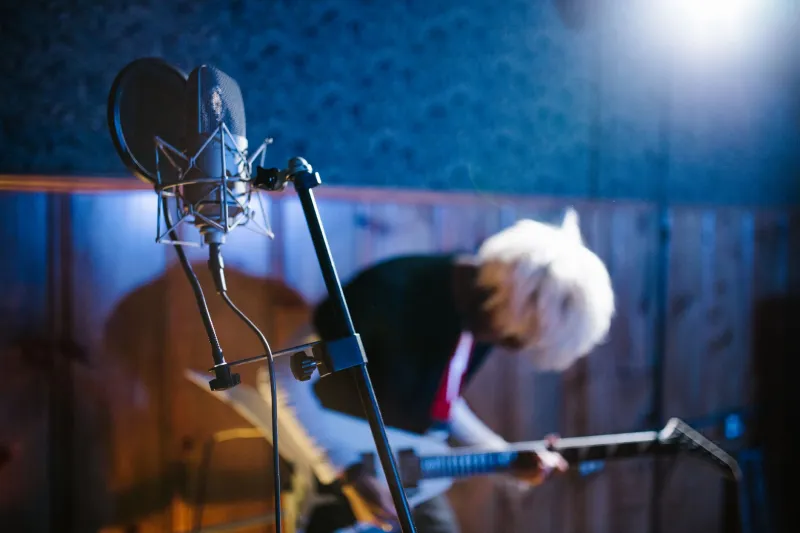
One of the most significant shifts in how young rock artists are developing their sound has nothing to do with influences — it has to do with infrastructure. The democratization of recording technology means that a 19-year-old with a laptop, an interface, and a decent microphone can produce a track that sounds genuinely professional. That changes the creative process in fundamental ways.
When you're working in a bedroom instead of a traditional studio, the pressure to sound a certain way drops dramatically. There's no engineer subtly steering you toward something more commercial. There's no producer with a strong opinion about what rock is supposed to be. You're free to layer a guitar riff under a drum machine, or run vocals through effects that have no precedent in the genre, or scrap the whole thing and start over at 2 a.m. because something isn't sitting right.
Artists like Beabadoobee — who started releasing music on SoundCloud as a teenager — built an entire aesthetic out of this kind of unfiltered bedroom experimentation. Her early stuff was lo-fi and intimate in a way that felt almost accidental, but the emotional core was rock through and through. Fuzzy guitars, confessional lyrics, a sense of volume and release. She just arrived there by a completely different road.
Hip-Hop Isn't the Enemy of Rock. It Never Was.
One of the most tired conversations in rock circles is the supposed conflict between rock and hip-hop. Older fans have spent decades treating this like a turf war. Younger artists have largely moved on from the argument entirely.
The crossover between rock energy and hip-hop production has been one of the most fertile creative zones of the past decade. Artists like Yungblud built careers on the collision — his music is loud, distorted, melodically aggressive, and structurally closer to pop-punk than anything else, but it lives comfortably in spaces where hip-hop fans feel at home. Fever 333 was doing something similar before their hiatus, fusing hardcore punk intensity with politically charged rap cadences in ways that felt urgent and necessary.
This isn't new, strictly speaking — the Beastie Boys and Run-DMC were doing genre fusion decades ago. But what's different now is that the fusion isn't a novelty. It's just how young musicians naturally hear things. The walls between sounds have been coming down for years, and Gen Z artists didn't build those walls to begin with.
The Emotional Core Hasn't Changed
For all the sonic experimentation happening in young rock, there's something that hasn't shifted: the emotional reason people reach for the genre in the first place. Rock has always been about expressing things that are hard to say any other way. Rage, grief, desire, alienation, the particular loneliness of being young and not quite fitting anywhere.
If anything, Gen Z artists are leaning into this harder than ever. The mental health honesty in a lot of current rock — artists talking openly about anxiety, depression, identity struggles — feels like a natural extension of what rock has always done. It's confessional. It's raw. It just doesn't always come wrapped in the same packaging.
Olivia Rodrigo's rock-leaning tracks, whatever you think of her pop crossover status, hit that emotional nerve in a way that clearly resonated with millions of young listeners who'd never called themselves rock fans before. That's not a threat to the genre. That's the genre doing what it's always done best.
What This Means for Rock's Future
The genre isn't in crisis. It's in flux, which is a completely different thing. Rock has always evolved through friction and reinvention — from blues to early rock and roll, from folk-rock to punk to grunge to post-rock, the genre has never stayed still for long. The artists who tried to freeze it in place were always the ones who got left behind.
The young musicians rebuilding rock right now aren't interested in being caretakers of a museum. They're interested in making something that feels true to their experience of being alive in 2024 — which means guitars might coexist with synthesizers, distortion might sit next to AutoTune, and a song might shift tempos in ways that would have made a 1970s producer's head spin.
At ROCS, we believe rock is a living thing. It breathes. It adapts. And right now, it's breathing through a generation that has no patience for gatekeeping and no interest in nostalgia for its own sake.
The noise is new. The energy is ancient. That combination is exactly what rock has always been.