Turn It Down: How Rock's Quieter Side Became Its Most Powerful Voice
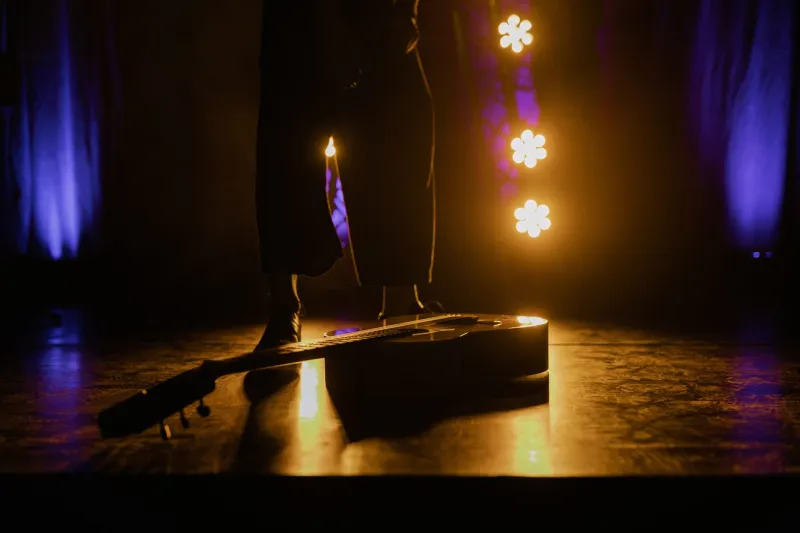
Rock music has always had a complicated relationship with vulnerability. For decades, the genre's dominant aesthetic ran on volume, swagger, and a studied indifference to anything that smelled like emotional exposure. Feelings were fine — as long as they were big feelings, performed loudly, preferably with a guitar solo attached.
Something has been quietly shifting. And the word quietly is doing real work in that sentence.
The Mood Has Changed
If you've been paying attention to what's resonating with rock listeners over the past few years, a pattern emerges. The albums getting passed around, the songs getting stitched into people's late-night playlists, the artists generating the kind of word-of-mouth that no marketing budget can manufacture — they're increasingly characterized not by their volume but by their honesty.
Phoebe Bridgers became one of the most talked-about figures in American rock not by turning up the gain but by turning it way, way down. Her songwriting — spare, precise, emotionally undefended — hit audiences with a force that plenty of louder records never managed. She wasn't the only one. Japanese Breakfast, Julien Baker, Boygenius, the War on Drugs, and a widening circle of artists have collectively made the case that rock's most powerful register might be something closer to a whisper than a roar.
Established acts have noticed. Artists who built careers on stadium-scale bombast have been releasing records that strip things back, lean into uncertainty, and trust the listener to meet them somewhere uncomfortable. It's not a gimmick. The audience is clearly ready for it.
What the Pandemic Broke Open
To understand why this is happening now, you have to reckon honestly with what the last several years actually did to people.
The pandemic didn't just disrupt schedules and supply chains. It cracked something open in the collective emotional life of the country. People were forced into an extended confrontation with anxiety, grief, isolation, and mortality — feelings that American culture, with its reflexive optimism and keep-moving energy, is generally not great at processing. The usual distractions weren't available. The noise got turned off, and in the silence, a lot of things that had been buried started surfacing.
When that happens to millions of people simultaneously, it changes what they need from art. The chest-thumping anthem — the one that tells you everything's going to be fine, that you're unstoppable, that the world is yours — can feel hollow when you've just spent two years staring at the ceiling at 3 a.m. What resonates instead is the song that says: I know. Me too. This is hard, and I'm not going to pretend otherwise.
Introspective rock doesn't just acknowledge that experience. It provides a container for it.
Redefining What "Rock" Is Allowed to Sound Like
This shift carries a cultural argument embedded inside it, and it's worth naming directly: the stereotype of rock as an inherently aggressive, externally directed genre has always been a partial picture at best.
Go back and listen to the quieter moments in the catalogs of artists who built the genre's reputation. Plenty of the most enduring rock songs are fundamentally about interior experience — about doubt, longing, confusion, the specific ache of being a person who doesn't quite fit. The loud-and-aggressive framing was always more about marketing than about the music's actual emotional range.
What's happening now feels less like a departure from rock's identity and more like a reclamation of something that was always there but frequently got drowned out. The artists leading this wave aren't abandoning rock — they're insisting on the full emotional spectrum the genre is capable of.
That's a meaningful distinction. It means this isn't a trend toward softness or a retreat from the genre's energy. It's an expansion of what rock is allowed to contain.
The Production Shift
The sonic choices being made in this space are deliberate and worth examining. Where a certain era of rock production was defined by compression, layering, and sheer sonic mass, the records connecting most deeply right now tend to favor space. You can hear the room. You can hear the breath. Imperfections are left in rather than edited out, because the imperfections are part of the point — they signal authenticity in a way that pristine production can undercut.
This is a learned response to the way listeners now engage with music. Headphones and earbuds have changed the experience of recorded sound in fundamental ways. When music is delivered directly into your ears rather than projected across a room, intimacy becomes a feature rather than a limitation. A vocal that sounds naked and unguarded in a car stereo becomes devastating on headphones at midnight. Producers and artists working in this space understand that, and they're making choices accordingly.
Is There Room for Both?
None of this means the big, loud, arena-ready rock song is finished. It isn't, and it shouldn't be. There's a reason those songs exist — they serve a real human need for catharsis, for collective energy, for the specific feeling of being in a crowd of thousands all experiencing the same sonic event simultaneously.
But the conversation in rock right now is no longer dominated by that mode. The critical attention, the cultural word-of-mouth, the sense of genuine artistic momentum — it's flowing toward the artists who are doing something quieter and harder to pull off: making you feel seen in your specific, private, often uncomfortable inner life.
That's not a small thing. That's rock music doing what it does at its best — meeting people where they actually are, rather than where the genre's mythology says they're supposed to be.
The Listeners Know
Ultimately, the clearest evidence that this shift is real and durable isn't critical consensus or streaming data. It's the way people talk about these records.
When someone describes an album by saying it felt like the artist had read their journal, or that they had to stop listening on the subway because they started crying, or that a particular song got them through something they couldn't put into words — that's the genre functioning at its highest level. That's not a niche response. That's rock doing what it always promised to do.
The quiet comeback isn't quiet at all, when you listen closely. It's just learned to make noise in a different way.