Stuck in the Wayback Machine: Is Rock's Retro Obsession Starting to Eat the Genre Alive?
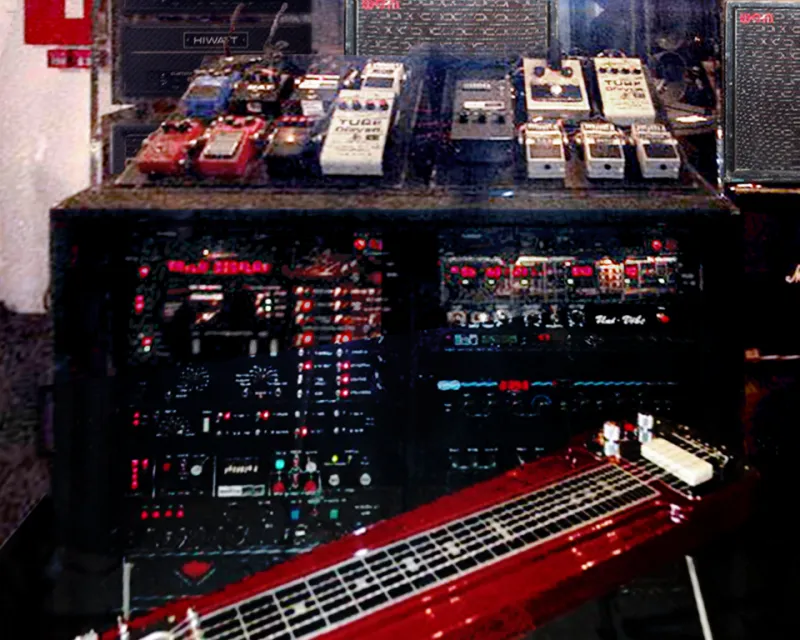
Photo: This file was derived from: Expo Pink Floyd - gilmour effects rack.jpg by Benoit Darcy from Paris, France Expo Pink Floyd - Hiwatt.jpg by Benoit Darcy from Paris, France Expo Pink Floyd - WEM.jpg by Benoit Darcy from Paris, France Expo Pink Floy
Let's start with something that should be unambiguously good news: a generation of young people is obsessed with classic rock. They're buying Zeppelin vinyl. They're streaming Rumours like it dropped last week. They're wearing Sabbath shirts and actually knowing who Black Sabbath is, which, if you grew up in the 90s, you understand is not something you could have taken for granted.
All of that is genuinely great. Rock history deserves to live and breathe, and if TikTok is the delivery mechanism for getting a 19-year-old from Ohio to fall in love with "Landslide," then TikTok has done something right.
But here's the part that's worth sitting with for a minute: at what point does deep love for the past start to crowd out the future?
The Museum Problem
Rock has always had a complicated relationship with its own mythology. The genre canonized itself early and hard. By the mid-80s, classic rock radio was already treating the 60s and 70s like sacred texts. By the 90s, you had a whole generation of bands — some brilliant, some not — explicitly building their sound on the bones of what came before.
That's not inherently bad. Influence is how culture works. Nobody invents anything from scratch.
But there's a difference between being influenced by the past and being consumed by it. And right now, in 2024 and beyond, the balance feels like it's tipping somewhere uncomfortable.
Scroll through any major rock playlist on Spotify. Browse the "sounds like" tags on new releases. Read the press copy for a dozen emerging rock acts. The references are overwhelming: 70s classic rock, 90s grunge, early-2000s post-punk revival. Everything is coded as a callback. Everything is positioned in relation to something that already existed.
When did "this sounds like it could have come out in 1975" become the highest compliment you can give a rock record?
Gen Z Didn't Start This Fire
To be clear: this isn't Gen Z's fault. The nostalgia industrial complex in rock has been running for decades. Classic rock radio formats, legacy act reunion tours, the endless reissue economy — these were all built by older generations and handed down as a kind of operating system for how you're supposed to relate to rock music.
Gen Z just inherited that system and, in some ways, accelerated it. The algorithm rewards familiarity. Sounds that reference things people already love perform well because they trigger recognition alongside emotion. That's not a cynical observation — it's just how recommendation engines work.
But the acceleration matters. When the nostalgia cycle speeds up, the window for genuinely new sounds to develop and find an audience gets compressed. Something that would have had five years to grow and mutate in a healthier ecosystem now has maybe one streaming cycle before it gets filed under a retro tag and moved on from.
The Revival Trap
Some of the most hyped rock acts of the past few years have been explicitly revival-coded. Bands leaning hard into 70s arena rock production. Artists whose entire aesthetic is assembled from 90s alternative signifiers. There's real craft in a lot of this work — don't get it twisted. But there's also a kind of safety in it that's worth naming.
Revival acts don't have to invent a new language. They're translating a language that already exists and already has an audience. That's a lower-risk creative move. And in a streaming economy where algorithmic placement can make or break an artist's career, lower-risk starts to look really attractive.
The problem is that rock's most important moments — the ones we're now endlessly nostalgic for — were almost never low-risk. They were disruptive. They were weird. They made people uncomfortable before they made people obsessed. Punk didn't sound like classic rock. Grunge didn't sound like punk. Each generation that moved rock forward did it by refusing to fully genuflect to what came before.
Where's that refusal right now?
Some Artists Are Doing the Hard Thing
It's not all retro-worship. There are artists out there genuinely pushing at the edges — blending rock structures with electronic production, incorporating hip-hop rhythms, building sounds that are hard to file neatly under any decade. Wet Leg had a moment of genuine freshness. Some of what's coming out of the math rock and post-hardcore underground doesn't sound like anything from 1973.
But these artists rarely dominate the mainstream conversation about rock's revival. They get critical respect, passionate small audiences, and then often get left out of the broader cultural narrative that positions rock's comeback as essentially a homecoming — a return to something that was always there.
The mainstream story of rock right now is largely a story about rediscovery. And rediscovery, by definition, looks backward.
The Question the Community Needs to Ask
Here at ROCS, we love rock history. That's not a small part of what we do — it's foundational. The past matters. Knowing where the music came from makes you a better listener and a better fan.
But the community has a real stake in asking the harder question: what does rock sound like when it's not looking over its shoulder?
Not "what does rock sound like when it's influenced by the past" — that's always going to be part of the answer. But what does it sound like when an artist isn't primarily trying to invoke a feeling from 1977 or 1994? What does rock sound like as a living, present-tense form of expression rather than a loving recreation of one?
That question is uncomfortable because it requires letting go of some of the comfort that nostalgia provides. It means being willing to sit with music that doesn't immediately feel familiar, that doesn't trigger the warm recognition of something you already love.
Rock built its entire mythology on artists who were willing to be uncomfortable. Who were willing to make music that didn't fit. The genre's past is full of people who didn't look backward — and that's exactly why we keep looking back at them.
Maybe the most authentic way to honor that legacy is to do what they actually did: face forward, make something nobody asked for, and see what happens.
The wayback machine is a great place to visit. It's a terrible place to live.